India Expands Strategic Deterrence Amid Growing Regional Challenges
The global nuclear landscape is changing rapidly. After decades of gradual reductions in nuclear stockpiles, major powers are once again investing heavily in nuclear weapons, missile systems, and strategic deterrence programs. Against this backdrop, India appears to be entering a new phase of nuclear preparedness, driven by evolving security concerns and the growing military capabilities of neighboring China and Pakistan.
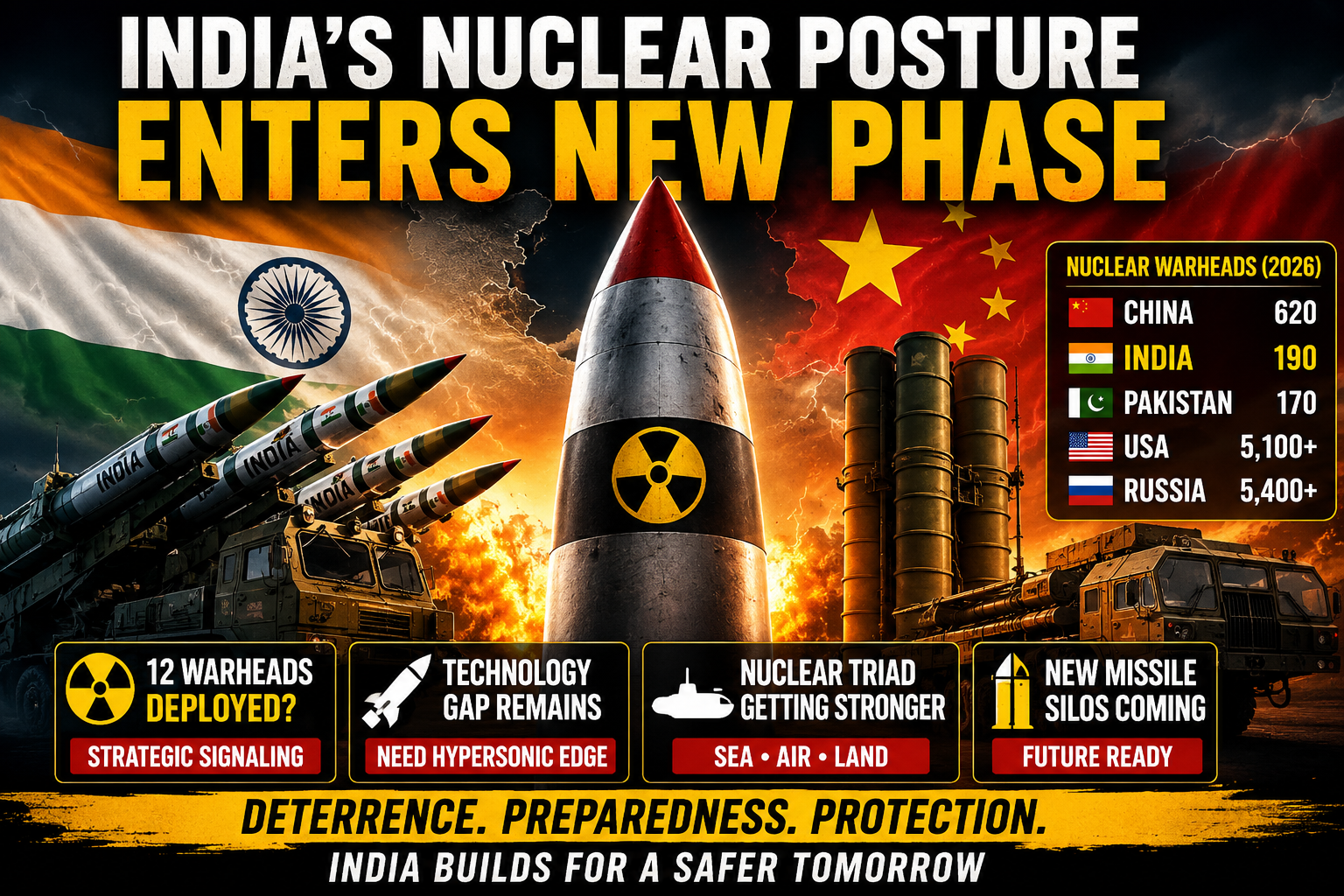
Recent assessments from the Stockholm International Peace Research Institute (SIPRI) suggest that India’s nuclear arsenal has reached approximately 190 warheads as of January 2026. The report also indicates that India may have begun occasionally deploying a small number of nuclear warheads on operational missile systems during peacetime, marking a significant development in the country’s nuclear posture.
The findings come at a time when global tensions are rising and many nations are reassessing their defense strategies in an increasingly uncertain world.
A Significant Shift in Nuclear Readiness
For many years, India’s nuclear doctrine emphasized maintaining warheads separately from delivery systems. This approach aligned with India’s policy of credible minimum deterrence and its long-standing commitment to responsible nuclear stewardship.
However, new assessments indicate that India may now be moving toward a more operationally ready nuclear force.
According to recent reports, approximately 12 Indian nuclear warheads are believed to have entered a deployed or near-ready status. While Indian authorities have not publicly confirmed these details, defense analysts view the development as a strategic signal aimed at strengthening deterrence.
The move does not necessarily indicate a change in India’s nuclear doctrine. Instead, experts suggest it reflects a response to a changing regional security environment, particularly the growing military capabilities of China and continued tensions with Pakistan.
In the world of nuclear strategy, deterrence often depends as much on perception as on actual capability. By demonstrating increased readiness, India may be seeking to reinforce the message that any aggression against the country would carry severe consequences.
SIPRI Warns of a Dangerous New Nuclear Era
The developments in South Asia are part of a broader global trend identified by SIPRI in its Yearbook 2026.
According to SIPRI, nuclear-armed states are increasingly relying on atomic weapons as instruments of national power. The organization warns that decades of progress toward reducing the role of nuclear weapons are now being reversed as geopolitical tensions intensify around the world.
SIPRI estimates that the world possesses approximately 12,187 nuclear warheads, with around 9,745 maintained in military stockpiles for potential use. Of those, roughly 4,012 are already deployed on missiles and aircraft.
Experts warn that modernization programs, declining transparency, weakening arms control agreements, and increasing geopolitical rivalries are creating a more dangerous international security environment than at any time in recent decades.
How India’s Arsenal Compares Globally
India’s estimated nuclear inventory of 190 warheads places it among the world’s major nuclear powers, although it remains significantly smaller than the arsenals maintained by the United States and Russia.
Estimated Nuclear Warheads in 2026
| Country | Estimated Warheads |
|---|---|
| Russia | Over 5,400 |
| United States | Over 5,100 |
| China | Around 620 |
| France | Around 290 |
| United Kingdom | Around 225 |
| India | Around 190 |
| Pakistan | Around 170 |
China’s rapid expansion is drawing particular attention from military planners worldwide. SIPRI estimates that China now possesses approximately 620 nuclear warheads and is expanding its arsenal faster than any other nuclear-armed state. The country has also constructed large missile silo fields and continues to modernize its strategic forces.
For India, China’s growing capabilities represent a long-term strategic challenge that increasingly shapes defense planning and modernization efforts.
The China Factor
Defense analysts increasingly believe that India’s nuclear modernization is being driven not only by Pakistan but also by China’s expanding military power.
SIPRI notes that India’s modernization efforts are becoming more focused on developing longer-range delivery systems capable of reaching targets across the Chinese mainland. The country is also investing in advanced missile technologies, sea-based deterrence systems, and improved survivability of its nuclear forces.
China’s growing arsenal, combined with its investments in advanced missile systems and strategic infrastructure, has altered the security calculations of countries throughout Asia.
The challenge for India is not simply matching warhead numbers. Military experts argue that future strategic competition will depend increasingly on technological sophistication, missile accuracy, mobility, survivability, and command-and-control capabilities.
The Technological Gap
While India’s nuclear arsenal continues to grow, analysts acknowledge that significant technological gaps remain between India and China.
One area frequently highlighted is hypersonic missile technology.
Hypersonic weapons travel at extremely high speeds while maintaining the ability to maneuver during flight, making them difficult to intercept using traditional missile defense systems.
China has invested heavily in hypersonic research and testing over the past decade. India has made substantial progress in indigenous missile development but continues working toward operational deployment of comparable systems.
Experts argue that future deterrence will depend not only on the number of warheads a nation possesses but also on the sophistication of delivery platforms and the ability to penetrate advanced defense networks.
As a result, India is expected to continue investing in missile modernization, strategic infrastructure, and emerging defense technologies in the coming years.
Building a Stronger Nuclear Triad
One of India’s major strategic priorities has been strengthening its nuclear triad.
A nuclear triad consists of three delivery methods:
- Land-based missiles
- Air-delivered nuclear weapons
- Sea-based nuclear systems
Maintaining all three components improves survivability because it ensures that a country’s deterrent capability cannot be neutralized through a single strike.
India has made notable progress in this area through the development of ballistic missile submarines and longer-range missile systems. SIPRI notes that sea-based capabilities are becoming increasingly important within India’s strategic framework because they provide a secure second-strike capability.
This capability remains a cornerstone of nuclear deterrence because it guarantees retaliation even after an enemy’s first strike.
Reports of New Missile Silos
Reports also suggest that India is investing in additional missile infrastructure, including the construction of new missile silos and supporting facilities.
While details remain limited, such projects are generally intended to enhance readiness, improve force dispersal, and strengthen long-term strategic resilience.
Infrastructure expansion reflects a broader global pattern. Nuclear powers around the world are modernizing launch systems, upgrading command networks, and investing in new technologies designed to ensure strategic credibility.
The trend is visible not only in India but also in China, the United States, Russia, France, and other nuclear-armed states.
A Delicate Balance in South Asia
The strategic relationship between India and Pakistan remains one of the most closely watched nuclear rivalries in the world.
Although both nations maintain nuclear deterrents, analysts note that each side has generally demonstrated caution during periods of heightened tension.
SIPRI observed that despite military confrontations in recent years, both countries took measures to prevent escalation into a larger conflict.
Nevertheless, the existence of nuclear weapons on both sides means that maintaining communication channels and crisis-management mechanisms remains essential for regional stability.
The Future of India’s Nuclear Strategy
India’s nuclear posture appears to be evolving in response to a rapidly changing strategic environment.
With an estimated 190 warheads, ongoing modernization programs, and increasing attention to operational readiness, the country is strengthening its deterrence capabilities while seeking to maintain strategic stability.
At the same time, India’s leadership faces complex choices. Expanding capabilities can enhance security, but it also requires balancing military preparedness with responsible stewardship and diplomatic engagement.
As global arms control agreements weaken and major powers continue to modernize their arsenals, the world may be entering a new nuclear era. In this environment, India’s strategic decisions will play an increasingly important role in shaping security dynamics across Asia and beyond.
The challenge ahead will not simply be building a larger arsenal. It will be ensuring that technological advancement, strategic restraint, and credible deterrence move forward together in a world where nuclear risks are once again rising.
About the Author