In international diplomacy, a single sentence can sometimes create more controversy than years of negotiations.
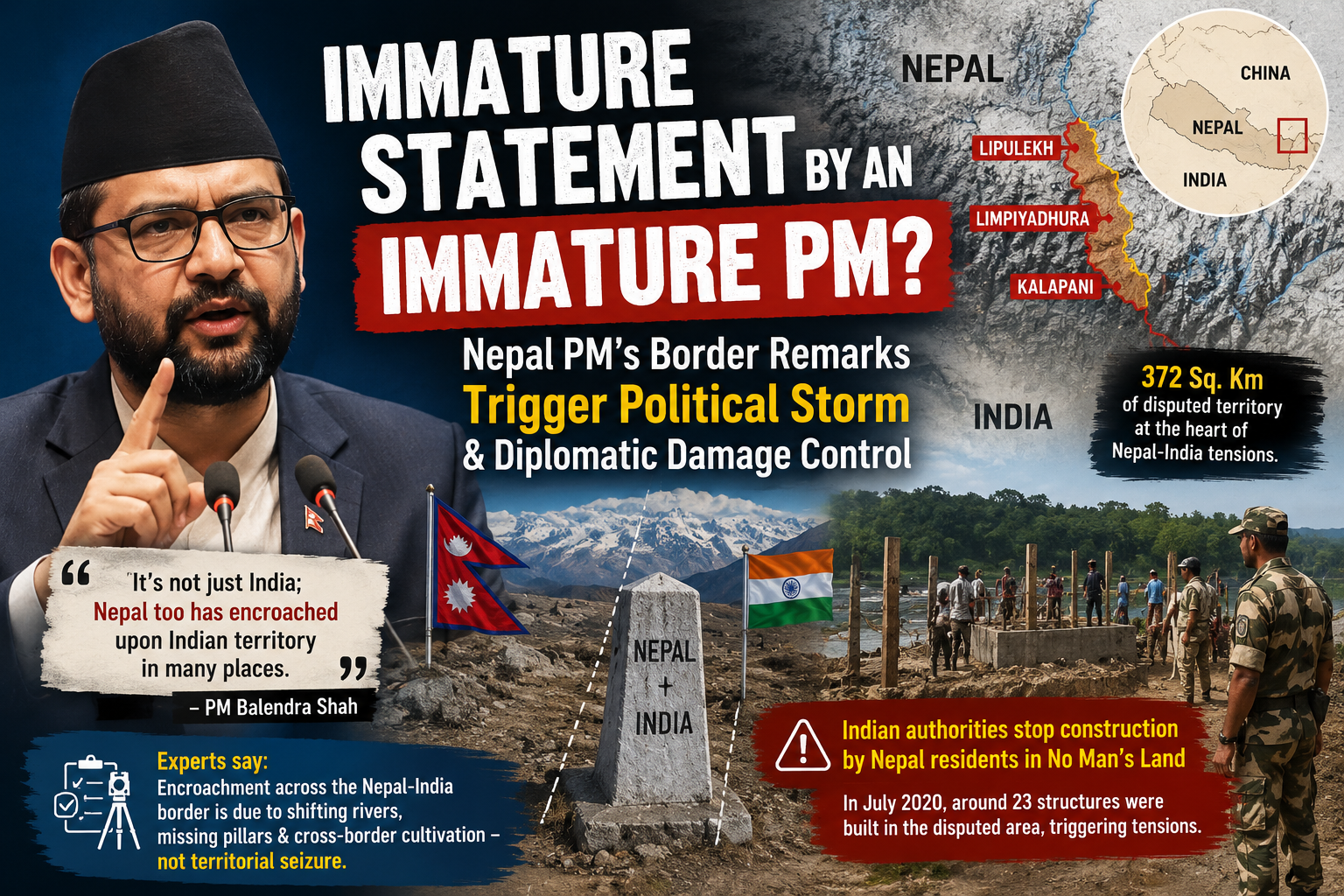
That is exactly what happened when Nepal Prime Minister Balendra Shah recently stated in Parliament that Nepal had also “encroached upon Indian territory in many places.”
The remark immediately sparked political outrage, criticism from border experts, concern among diplomats, and confusion among citizens. Within hours, Nepal’s government found itself attempting damage control as opposition leaders, former survey chiefs, and foreign policy experts challenged the Prime Minister’s statement.
The controversy has once again brought attention to the sensitive and complex Nepal-India border relationship, particularly regarding disputed regions such as Lipulekh, Limpiyadhura, and Kalapani.
But beyond the political headlines lies a bigger question:
Did Nepal really encroach upon Indian territory, or was the Prime Minister’s statement a misunderstanding of complicated border realities?
The Statement That Started the Firestorm
During a parliamentary session, Prime Minister Balendra Shah responded to lawmakers questioning the government’s approach toward the long-standing Kalapani, Lipulekh, and Limpiyadhura disputes.
Instead of solely focusing on India’s alleged occupation of disputed territory, Shah made an unexpected admission.
He stated that Nepal too had occupied Indian land in various locations and that he himself only learned this after becoming Prime Minister.
The statement immediately became national news.
Opposition parties accused the Prime Minister of weakening Nepal’s official position regarding territorial disputes with India.
Many lawmakers demanded clarification, while others called for the statement to be removed from parliamentary records.
Why Experts Disagree With the PM
Former survey officials and border experts quickly challenged the Prime Minister’s remarks.
According to experts who have spent decades studying Nepal’s international boundaries, there is a major difference between:
- State-sponsored territorial encroachment
- Cross-border cultivation by local residents
- Disputes caused by shifting rivers
- Missing or damaged border pillars
Experts argue that Nepal has never officially occupied Indian territory as a state policy.
Instead, many border complications arise because local residents on both sides farm land that technically falls across the border.
This phenomenon is known as cross-border occupation or cross-holding.
It is not considered territorial annexation.
The Real Problem: Rivers Don’t Respect Maps
One of the biggest challenges along the Nepal-India border is geography itself.
Large sections of the border were historically defined using rivers and streams.
Over decades, these rivers naturally changed their courses.
When rivers move:
- Old boundary markers become inaccurate.
- Agricultural land changes position.
- Villages find themselves closer to one country than another.
- Border pillars disappear due to floods and erosion.
As a result, confusion develops regarding ownership and usage of land.
Experts say many of today’s border issues stem from these geographical realities rather than deliberate territorial expansion.
Nature, as usual, ignored human paperwork. Rivers never attended diplomatic meetings.
What Survey Records Actually Show
According to Nepal’s border survey completed in 2007, researchers discovered that citizens from both countries were cultivating land across the international boundary.
The survey found:
- Around 1,200 hectares of Nepali land being used by Indian citizens.
- Around 1,250 hectares of Indian land being used by Nepali citizens.
However, experts stress that these findings do not mean either government officially seized territory.
They simply reflect decades of local agricultural activity across a porous border.
Former survey officials have repeatedly emphasized that the issue is administrative and technical, not evidence of national territorial aggression.
Kalapani, Lipulekh and Limpiyadhura: A Different Issue
The controversy becomes even more sensitive because Shah’s remarks came while discussing the Kalapani dispute.
Nepal maintains that:
- Kalapani
- Lipulekh
- Limpiyadhura
are historically part of Nepal.
Nepali experts cite the 1816 Treaty of Sugauli and multiple historical maps prepared during British India as evidence supporting Nepal’s claims.
The disputed region covers approximately 372 square kilometers and has strategic importance due to its location near India, Nepal, and China.
India has administered the area since the 1962 Sino-Indian War.
Both nations continue to maintain their respective claims.
For many critics, Shah’s statement appeared to weaken Nepal’s diplomatic position on this highly sensitive issue.
Nepal’s Attempt to Involve the United Kingdom
Adding another interesting dimension to the dispute, Nepal has reportedly explored discussions with the United Kingdom.
The logic behind this approach is straightforward.
The current border dispute traces its roots back to the 1816 Treaty of Sugauli, signed between Nepal and the British East India Company.
Some Nepalese officials believe Britain may possess historical records and maps that could assist in clarifying territorial claims.
However, reports indicate British representatives have maintained that the matter should primarily remain a bilateral issue between Nepal and India.
The United Kingdom appears reluctant to play a direct role in resolving the dispute.
Perhaps a reminder that former colonial powers rarely volunteer to revisit centuries-old border complications unless absolutely necessary.
India’s Concerns Along the Border
The debate over border management is not entirely one-sided.
Several incidents over the years have generated concerns among Indian authorities as well.
One notable example occurred in 2020 near the India-Nepal border in Uttarakhand’s Champawat district.
Indian authorities halted construction activities being carried out by Nepalese residents in the No Man’s Land area near the border.
According to local officials:
- Construction involved wooden and concrete structures.
- The area was considered disputed.
- Nepalese residents claimed ownership.
- Indian authorities objected to the construction.
Reports suggested approximately 23 structures had been built.
Indian officials raised the issue with Nepalese authorities, who reportedly assured that the structures would be removed after investigation.
The incident demonstrated how local disputes can quickly escalate into diplomatic concerns if not addressed promptly.
Missing Border Pillars Create Endless Confusion
Another major challenge involves missing boundary pillars.
The Nepal-India border contains thousands of markers designed to indicate the exact international boundary.
Over time, many have:
- Disappeared
- Shifted
- Been damaged
- Become difficult to identify
When a pillar goes missing, uncertainty follows.
Local residents may unintentionally begin using land that belongs to the neighboring country.
Over decades, temporary arrangements become permanent realities on the ground.
This is one reason why both countries established joint boundary working groups to identify, repair, and restore border markers.
Political Backlash Intensifies
Following Shah’s remarks, criticism spread rapidly.
Opposition leaders questioned whether the Prime Minister had spoken in his personal capacity or was presenting an official government position.
Former diplomats also challenged the characterization that Nepal had occupied Indian territory.
Critics argued that such statements could create confusion internationally and undermine Nepal’s long-standing claims in disputed regions.
Several political figures demanded evidence supporting the Prime Minister’s assertion.
Others called for an immediate clarification to avoid diplomatic misunderstandings.
The backlash highlighted how sensitive border issues remain in Nepalese politics.
Government Launches Damage Control
As criticism intensified, Nepal’s Foreign Ministry issued a clarification.
According to the ministry:
The Prime Minister’s comments were intended to refer to:
- Cross-border occupation.
- Cultivation across boundaries.
- Usage of land in no-man’s-land areas.
- Technical complications resulting from fixed-boundary principles.
The ministry emphasized that the issue involves local land usage rather than state-sponsored territorial encroachment.
This clarification was widely viewed as an effort to contain political damage and reassure critics.
Whether it succeeded remains open to debate.
The Bigger Lesson for South Asia
The controversy offers an important lesson for the entire region.
South Asia contains numerous borders shaped by:
- Colonial-era agreements.
- Historical maps.
- Shifting rivers.
- Ethnic communities spread across boundaries.
Managing such borders requires precision, diplomacy, and careful communication.
When national leaders discuss territorial matters, every word carries weight.
A poorly framed statement can create domestic controversy, strain diplomatic relationships, and complicate ongoing negotiations.
Border disputes are rarely resolved through emotional rhetoric.
They require facts, historical evidence, technical expertise, and sustained dialogue.
Conclusion
Prime Minister Balendra Shah’s remarks have reignited debate about Nepal’s border challenges and its relationship with India.
While experts largely reject the claim that Nepal has officially encroached upon Indian territory, they acknowledge that cross-border cultivation and land usage remain genuine issues.
The government’s subsequent clarification suggests that the Prime Minister may have intended to describe these local realities rather than make a formal territorial admission.
Nevertheless, the controversy demonstrates how sensitive border politics remain in South Asia.
As Nepal and India continue discussions over Kalapani, Lipulekh, Limpiyadhura, and other unresolved issues, careful diplomacy will matter more than ever.
Because in international relations, borders may be drawn on maps, but trust is built through words. And sometimes, one sentence can create a bigger storm than the border dispute itself.
Read More:
About the Author