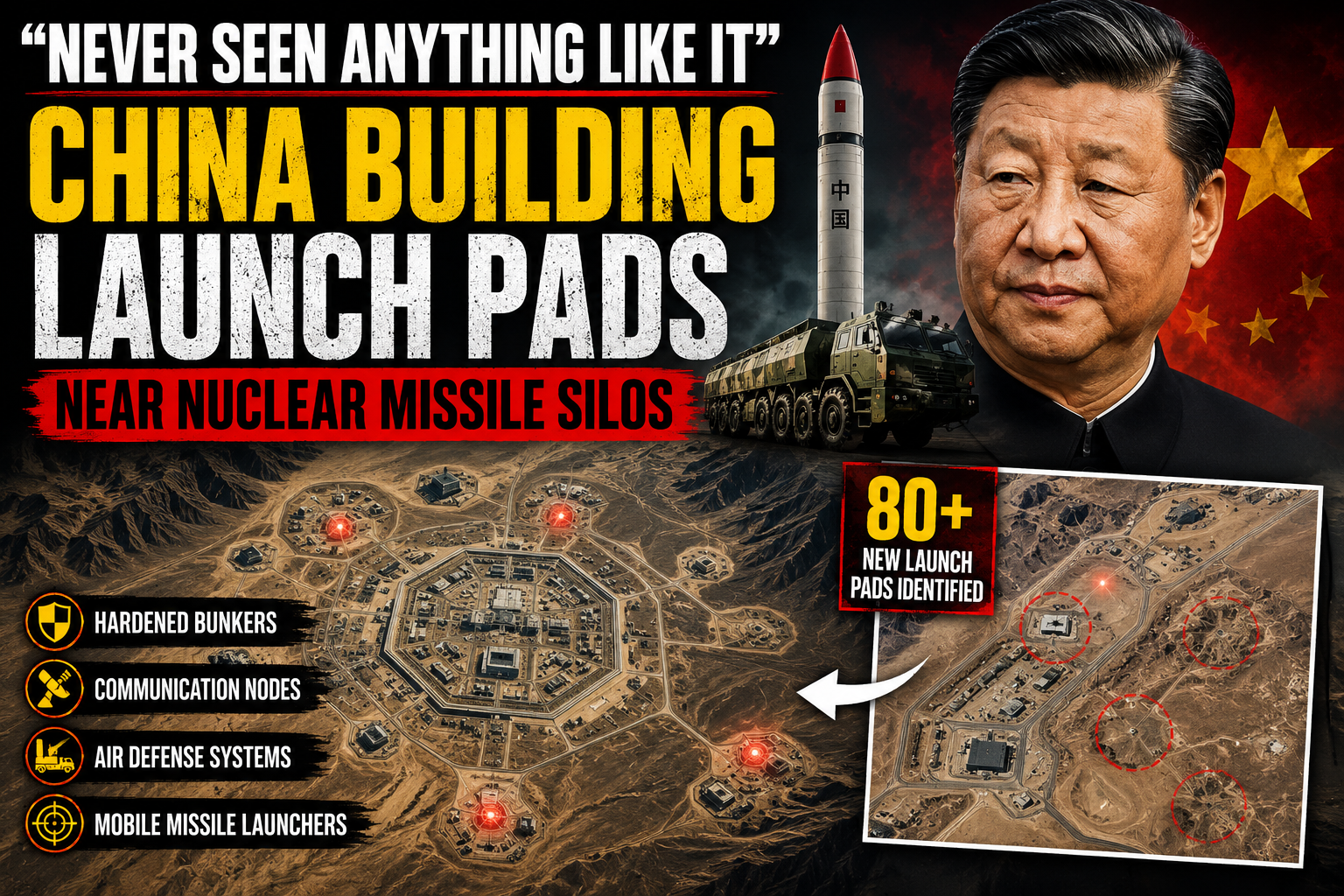
Satellite Images Reveal China’s Expanding Nuclear Infrastructure
The global balance of power may be entering a new chapter. Newly analyzed satellite images have revealed that China is rapidly expanding military infrastructure around some of its most important nuclear missile facilities. The development has caught the attention of defense experts worldwide, with some analysts describing the scale of construction as unprecedented.
Located deep within the remote deserts of northwestern China, the newly discovered network includes launch pads, fortified bunkers, communication facilities, transportation links, and defensive military positions. Experts believe the project is part of Beijing’s broader effort to strengthen its nuclear deterrence capability and ensure its ability to respond to any potential attack.
As tensions continue to rise between China and the United States over issues such as Taiwan, military modernization and strategic deterrence have become increasingly important components of national security planning.
What Do The Satellite Images Show?
Recent satellite imagery reveals an extensive military network spread across thousands of square kilometers of desert terrain.
The construction reportedly includes:
- More than 80 potential launch pad locations
- Reinforced underground bunkers
- Military command and communication facilities
- Transportation corridors connecting strategic sites
- Air defense deployment zones
- Possible electronic warfare installations
- Satellite communication infrastructure
Defense analysts note that these facilities appear strategically positioned near China’s long-range missile silo fields, which house some of the country’s most powerful intercontinental ballistic missiles (ICBMs).
The sheer scale of the development suggests that China is not merely upgrading existing infrastructure but creating a highly resilient military network designed to survive even under extreme conflict scenarios.
Why Is China Building These Facilities?
Military experts believe the primary objective is to strengthen China’s “second-strike capability.”
In nuclear strategy, second-strike capability refers to a country’s ability to launch a retaliatory nuclear attack even after suffering an enemy’s first strike.
This concept forms the foundation of modern nuclear deterrence.
A nation with a credible second-strike capability is less likely to be attacked because adversaries know retaliation remains possible regardless of initial battlefield success.
China has long maintained that its nuclear policy is defensive in nature and based on a “No First Use” doctrine. Under this policy, Beijing states that it would not initiate a nuclear attack but would reserve the right to retaliate if attacked with nuclear weapons.
The newly discovered infrastructure appears consistent with this strategic approach.
The Importance of China’s Desert Missile Fields
China’s northwestern regions, particularly Xinjiang and Gansu provinces, have become central to its nuclear modernization efforts.
Over the last several years, researchers have identified hundreds of missile silos under construction in these remote areas.
Several factors make these regions ideal for strategic military facilities:
Geographic Isolation
The vast deserts provide natural concealment and reduce civilian exposure.
Security Advantages
Remote locations are easier to monitor and defend against infiltration.
Strategic Depth
Distance from coastlines and international borders adds an additional layer of protection.
Space for Expansion
The sparsely populated terrain allows large-scale military development without major disruption.
The latest satellite evidence indicates that China is now expanding beyond silo construction and developing a comprehensive support ecosystem around these strategic assets.
The Mysterious Octagon-Shaped Military Complexes
One of the most intriguing discoveries is the presence of large octagon-shaped installations located near the missile fields.
These structures appear to serve as operational hubs connected to numerous surrounding military facilities.
Satellite imagery shows that these sites contain:
- Housing for military personnel
- Storage facilities
- Vehicle staging areas
- Defensive fortifications
- Road and rail connections
- Communication infrastructure
Military analysts believe these installations could function as command centers responsible for coordinating missile operations, logistics, maintenance, and defensive activities.
The unusual design and scale of the facilities have generated significant interest among security researchers.
Mobile Missile Launchers Could Play A Key Role
Another notable feature identified in satellite images is a network of launch pads spread throughout the surrounding desert.
Experts suggest some of these sites may support mobile missile launchers.
Unlike fixed silos, mobile launch systems offer several advantages:
Increased Survivability
Mobile launchers can relocate frequently, making them harder to target.
Greater Operational Flexibility
They can be deployed from multiple locations.
Enhanced Strategic Uncertainty
Adversaries face greater difficulty tracking and neutralizing them.
Stronger Deterrence
The uncertainty surrounding launcher locations increases the credibility of retaliation capabilities.
Many modern nuclear powers use a combination of fixed and mobile systems to improve deterrence effectiveness.
Advanced Communications And Electronic Warfare Capabilities
The satellite imagery also points to the development of sophisticated communication infrastructure.
Analysts have identified:
- Large communication towers
- Satellite dishes
- Underground conduit systems
- Possible fiber-optic networks
- Electronic warfare facilities
These systems are critical for command, control, and communications during military operations.
In any nuclear scenario, reliable communication is essential for transmitting orders, monitoring threats, and coordinating defensive responses.
Without secure communication networks, even the most advanced missile systems become significantly less effective.
China’s Growing Nuclear Arsenal
China’s nuclear modernization efforts have accelerated dramatically over the past decade.
While China still maintains fewer nuclear warheads than the United States and Russia, it is steadily expanding its capabilities.
Recent defense assessments suggest that Beijing is pursuing a more modern and diversified nuclear force that includes:
Land-Based Missiles
Intercontinental ballistic missiles capable of reaching targets across continents.
Submarine-Launched Missiles
Nuclear weapons deployed from strategic submarines.
Air-Launched Nuclear Systems
Aircraft capable of delivering nuclear payloads.
This combination creates what military strategists call a “nuclear triad,” providing multiple options for deterrence and retaliation.
Taiwan Tensions And Strategic Competition
The timing of these developments is particularly significant.
Relations between China and the United States remain strained over several issues, with Taiwan being one of the most sensitive.
China considers Taiwan part of its territory and has repeatedly emphasized its intention to achieve reunification.
Taiwan’s government, however, maintains its own political system and rejects Beijing’s sovereignty claims.
As military competition intensifies in the Indo-Pacific region, both nations continue investing heavily in advanced defense technologies, missile systems, and strategic capabilities.
The expansion of China’s nuclear infrastructure reflects broader concerns about long-term geopolitical competition.
How Does This Compare To The United States And Russia?
The United States and Russia possess the world’s largest nuclear arsenals.
Historically, both countries have relied on:
- Large numbers of missile silos
- Hardened underground facilities
- Strategic submarines
- Advanced early-warning systems
However, analysts note that China’s approach appears somewhat different.
Rather than relying solely on hardened silos, Beijing appears to be creating an extensive network of supporting infrastructure, mobile deployment options, communication systems, and defensive assets around its missile fields.
This layered approach could improve survivability and operational resilience during a crisis.
Why Experts Are Calling It Extraordinary
Defense researchers who have studied nuclear infrastructure for decades describe the scale of the project as remarkable.
Several factors stand out:
- Massive geographic footprint
- High level of integration between facilities
- Significant investment in survivability
- Extensive communication networks
- Defensive military positioning
- Long-term strategic planning
For many observers, the development demonstrates China’s determination to ensure that its nuclear forces remain credible and effective well into the future.
Whether viewed as a defensive measure or part of a broader strategic competition, the construction highlights the growing importance of nuclear deterrence in modern geopolitics.
What This Means For Global Security
The expansion of China’s nuclear infrastructure does not necessarily indicate an imminent conflict.
However, it does signal an evolving security environment where major powers are investing heavily in strategic deterrence capabilities.
As China, the United States, and Russia continue modernizing their nuclear forces, transparency, communication, and diplomatic engagement become increasingly important for reducing misunderstandings and maintaining stability.
The newly revealed satellite images provide a rare glimpse into one of the world’s most closely watched military modernization programs.
What is emerging in China’s remote deserts may shape strategic calculations for decades to come.
Conclusion
China’s expanding military infrastructure in its northwestern deserts represents one of the most significant strategic construction projects observed in recent years. From launch pads and fortified bunkers to advanced communications networks, the development appears aimed at ensuring the survivability and effectiveness of Beijing’s nuclear forces.
As geopolitical competition continues to evolve, these satellite images offer valuable insight into how major powers are preparing for future security challenges. Whether viewed through the lens of deterrence, defense, or strategic rivalry, the message is clear: China’s nuclear modernization effort is accelerating, and the world is paying close attention.
Related Resource:
About the Author





1 thought on “China’s Massive Nuclear Expansion: Satellite Images Reveal New Launch Pads Near Missile Silos”