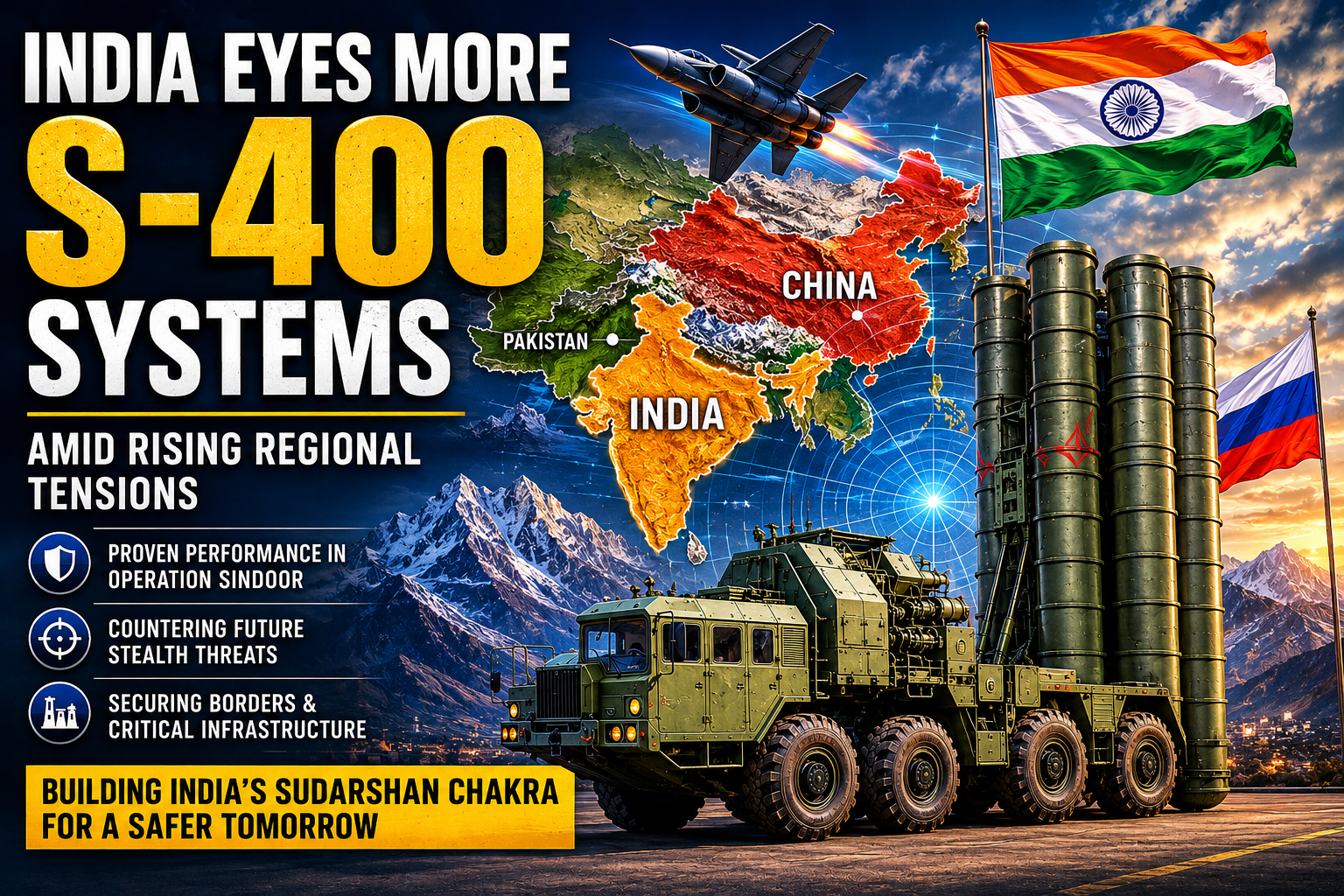
In a move that signals New Delhi’s growing focus on air defense modernization, Russia has officially confirmed that India is in discussions to acquire additional S-400 Triumf missile defense systems. The development comes at a time when South Asia’s security landscape is becoming increasingly complex, with rising military competition, evolving aerial threats, and deepening geopolitical tensions across the region.
According to recent reports, Russia’s Federal Service for Military-Technical Cooperation (FSMTC) acknowledged that India has formally shown interest in expanding its current S-400 inventory. The announcement has reignited discussions around India’s long-term defense planning and its strategy to secure critical infrastructure, border regions, and airspace against emerging threats.
Humanity really did build flying stealth machines worth billions of dollars only to invent even bigger missiles to shoot them down. Civilization is basically an extremely expensive multiplayer strategy game with nuclear consequences. 😵💫
India’s Existing S-400 Deployment
India signed its original S-400 deal with Russia in 2018, valued at approximately $5.4 billion. The agreement included five squadrons of the advanced air defense system, widely considered one of the most sophisticated long-range missile defense platforms currently operational.
So far, India has reportedly received three operational S-400 units, while the remaining deliveries are expected to arrive by 2026. These systems have already been strategically deployed in sensitive regions, including:
- Areas near the Pakistan border
- The Siliguri Corridor
- Northeastern India
Each deployment location reflects India’s broader security concerns involving both Pakistan and China. The Siliguri Corridor, often called the “Chicken’s Neck,” remains particularly important because it connects mainland India with the northeastern states. Military planners consider it one of the country’s most vulnerable strategic regions.
The S-400 system provides India with the ability to detect, track, and engage multiple aerial threats simultaneously. These include:
- Fighter aircraft
- Ballistic missiles
- Cruise missiles
- Surveillance aircraft
- Drones
- Certain stealth targets
Its range and layered interception capability significantly enhance India’s defensive posture in contested airspace.
Why India Wants More S-400 Systems
The latest interest in additional batteries appears to be driven by a mix of operational experience and future threat calculations.
Reports and strategic discussions suggest the S-400 system performed effectively during a recent Indian military operation referred to as “Operation Sindoor.” Analysts claim the air defense network successfully neutralized several hostile aerial threats, reinforcing confidence in the platform’s capabilities.
While official operational details remain limited, the reported performance has likely strengthened India’s desire to expand its defensive umbrella.
Military experts also point toward changing regional airpower dynamics. One of the key concerns involves the possibility of Pakistan acquiring advanced fifth-generation fighter aircraft such as China’s J-35 stealth jet in the future.
Stealth fighters are designed to reduce radar visibility and penetrate conventional air defense systems. For nations facing these aircraft, layered missile defense becomes increasingly critical.
India’s interest in additional S-400 batteries may therefore represent a proactive strategy rather than a reactive purchase.
Defense planners generally prefer building capabilities years before a threat fully materializes. Waiting until rival aircraft are already operational is the strategic equivalent of installing antivirus software after downloading twelve suspicious files named “FreeMovie2026.exe.” Humanity keeps repeating this pattern with terrifying consistency. 💀
The Strategic Importance of Air Defense in Modern Warfare
Modern warfare has shifted dramatically over the past two decades. Air superiority now plays a decisive role in determining battlefield outcomes, and missile defense systems have become central to national security planning.
Conflicts across the world have demonstrated how drones, cruise missiles, and precision-guided munitions can disrupt military infrastructure, logistics hubs, and civilian assets within minutes.
For India, this challenge is amplified by its geographic reality.
The country faces two nuclear-armed neighbors with advanced missile capabilities and rapidly modernizing air forces. As a result, India has increasingly prioritized integrated air defense systems capable of covering large areas and responding to multiple simultaneous threats.
The S-400 offers several strategic advantages:
Long Detection Range
The radar systems associated with the S-400 can reportedly track targets hundreds of kilometers away, giving operators valuable reaction time.
Multi-Layered Interception
The platform uses different missile types designed for short, medium, and long-range interception. This layered approach improves overall defensive effectiveness.
Simultaneous Target Engagement
The system can engage multiple targets at once, which is crucial during saturation attacks involving drones and missiles.
Psychological Deterrence
Possessing advanced missile defense systems can influence enemy operational planning and reduce the likelihood of aerial aggression.
Military strategy has always had a strange psychological component. Half the objective is protection. The other half is convincing your rival that attacking you would become an accounting nightmare with explosions.
Russia-India Defense Relations Remain Strong
Despite shifting global alliances and increasing Western pressure on Russian defense exports, India and Russia continue to maintain deep military cooperation.
For decades, Russia has been one of India’s largest defense suppliers. Indian armed forces still rely heavily on Russian-origin platforms, including:
- Fighter aircraft
- Tanks
- Submarines
- Missile systems
- Naval assets
The S-400 deal itself became internationally controversial because it triggered concerns under the United States’ CAATSA sanctions framework, which targets countries purchasing major Russian defense equipment.
However, India managed to maintain strategic flexibility by balancing relations with both Russia and Western nations.
This balancing act has become a defining feature of India’s foreign policy. New Delhi continues strengthening ties with the United States, Europe, and Indo-Pacific allies while simultaneously preserving long-standing defense partnerships with Moscow.
From a geopolitical standpoint, India’s approach reflects pragmatic realism rather than ideological alignment.
Countries do not survive long by conducting foreign policy like emotional social media debates. Nations operate on interests, logistics, fuel supplies, shipping lanes, and cold calculations. The comment section mentality fortunately does not run missile command centers. Mostly.
Water Security and Strategic Infrastructure Concerns
Another important aspect emerging from recent discussions is the link between military preparedness and infrastructure protection.
Analysts have increasingly connected regional defense planning with concerns surrounding water security and strategic river infrastructure.
The ongoing tensions related to the Indus Water Treaty and management of rivers such as the Chenab have intensified debates about safeguarding dams, hydropower facilities, and critical water resources.
Infrastructure security is now considered part of broader national defense strategy.
In any future conflict scenario, large dams and water-control systems could become high-value strategic targets. Air defense systems like the S-400 may therefore play a role not only in protecting cities and military bases but also in securing economic and environmental infrastructure.
This reflects a broader global trend where modern warfare extends far beyond traditional battlefields.
Cyber networks, satellite systems, energy infrastructure, and water resources have all become strategic assets requiring protection.
Could Deliveries Accelerate?
Some analysts believe the timeline for additional S-400 deliveries could depend heavily on developments surrounding the Russia-Ukraine war.
Russia’s defense manufacturing sector has been under enormous pressure due to wartime demand and sanctions-related constraints. Production capacity has been prioritized for domestic military requirements, which affected several international defense contracts.
However, if the conflict eventually stabilizes or de-escalates, manufacturing and export schedules could potentially accelerate.
India would likely prefer faster delivery timelines, especially given the rapidly evolving security environment across Asia.
Still, large-scale military procurement agreements involve lengthy negotiations, logistical planning, training integration, and payment mechanisms. Even after formal approval, implementation may take years.
Defense procurement moves at the speed of ancient glaciers carrying paperwork. Somewhere on Earth right now, three generals, five bureaucrats, and a finance ministry official are debating comma placement in a missile contract worth billions. 🫠
The Bigger Picture for India’s Defense Future
India’s pursuit of additional S-400 systems reflects a broader transformation underway within its military doctrine.
The country is increasingly focused on:
- Building layered air defense
- Expanding domestic defense manufacturing
- Enhancing surveillance capabilities
- Integrating advanced radar systems
- Preparing for multi-domain warfare
The future battlefield will likely involve a combination of drones, stealth aircraft, hypersonic missiles, cyber attacks, and electronic warfare systems operating simultaneously.
In such an environment, advanced air defense becomes not just useful but essential.
India’s investment in systems like the S-400 indicates that policymakers are preparing for long-term strategic competition rather than isolated short-term crises.
The concept often described as India’s “Sudarshan Chakra” defense shield symbolizes this larger ambition: creating a robust protective network capable of deterring hostile action while ensuring strategic stability.
Conclusion
Russia’s confirmation that India is considering additional S-400 missile systems marks another significant chapter in the country’s evolving defense strategy.
With regional tensions continuing to shape military planning, New Delhi appears determined to strengthen its aerial defense capabilities against both present and future threats.
The move reflects not only concerns about neighboring airpower developments but also a wider understanding that modern national security depends on protecting infrastructure, maintaining deterrence, and preparing for increasingly sophisticated warfare environments.
Whether the final deal materializes soon or takes years to complete, one thing is becoming increasingly clear: air defense will remain a central pillar of India’s strategic planning in the coming decade.
And somewhere above all this, satellites are quietly watching humans spend trillions building machines to ensure other humans do not cross invisible lines on maps. History remains undefeated. 🌍
Source Reference:
The Moscow Times Report on India-Russia S-400 Talks
About the Author