Iran Taj Mahal Controversy: Why Marco Rubio’s Visit Sparked a Global Debate
Iran Taj Mahal Controversy Begins After Marco Rubio’s Visit
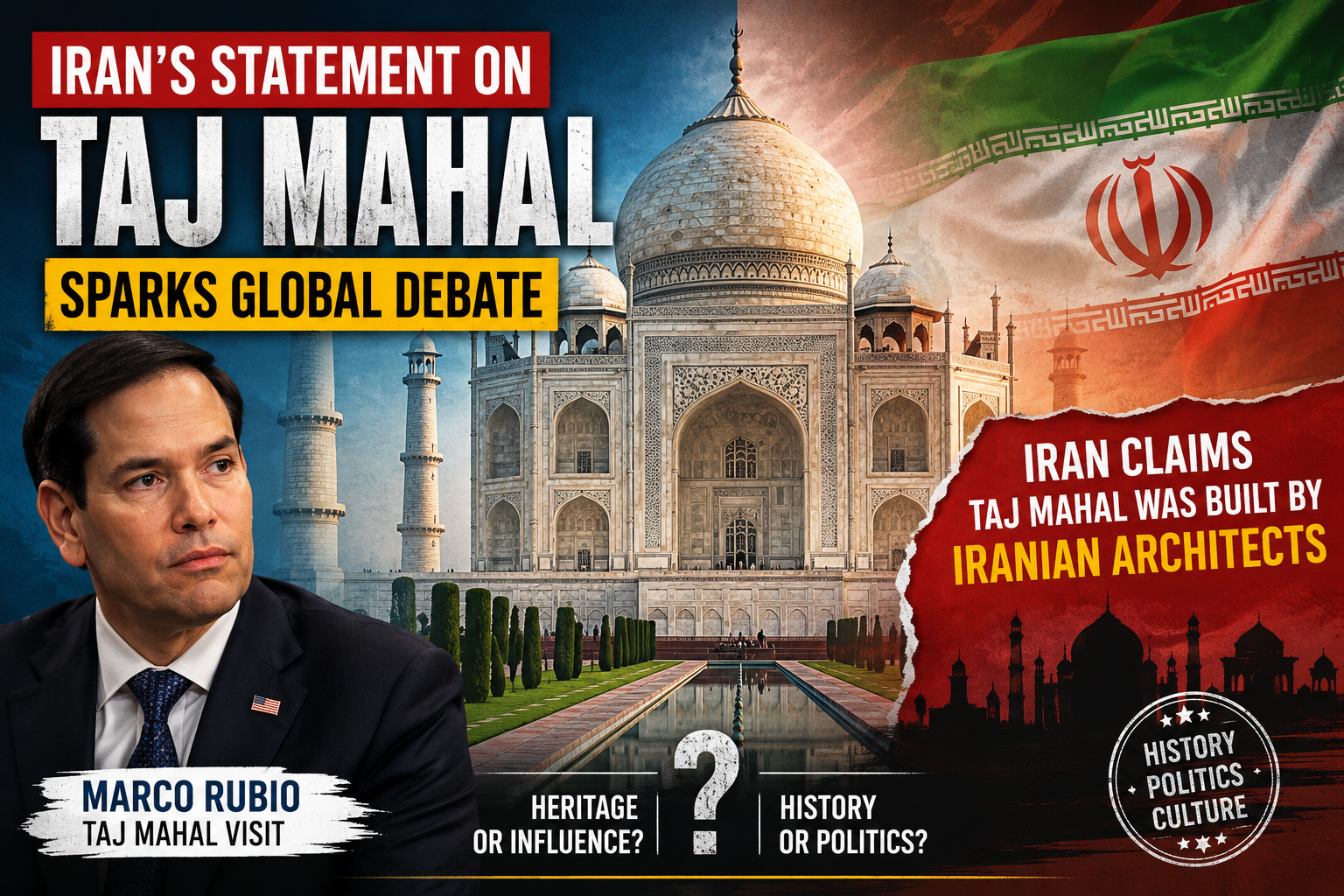
The Iran Taj Mahal controversy has unexpectedly become one of the most discussed cultural and political debates online after U.S. Secretary of State Marco Rubio visited the iconic Taj Mahal during his India tour.
What looked like a routine diplomatic visit quickly transformed into an international debate after Iran’s diplomatic mission in India reportedly objected to the symbolism of the visit. According to the statement, Iranian officials argued that the Taj Mahal was significantly influenced by Persian architects and artisans, making it deeply connected to Iranian cultural history.
Within hours, social media exploded with arguments over history, architecture, nationalism, and cultural ownership. Humanity somehow took a marble monument built as a symbol of love and converted it into another geopolitical cage fight. The internet remains undefeated 😅
But beneath the outrage and political noise lies a more important question:
Who truly “owns” historical heritage shaped by multiple civilizations?
What Triggered the Iran Taj Mahal Controversy?
The controversy started when Marco Rubio visited the Taj Mahal during his diplomatic trip to India. The monument is one of the most recognized landmarks in the world and a common stop for international leaders visiting the country.
However, Iran’s diplomatic mission reportedly criticized the visit in a statement emphasizing Persian contributions to the Taj Mahal’s architecture. The remarks suggested that ignoring those historical contributions while tensions remain high between the United States and Iran could be interpreted as disrespectful.
The statement immediately divided public opinion.
Some people viewed the Iranian comments as a valid reminder of Persian artistic influence on Mughal architecture. Others saw it as an unnecessary attempt to politically appropriate one of India’s greatest cultural symbols.
The debate quickly spread across YouTube, X, Instagram, blogs, and political discussion forums.
Was the Taj Mahal Designed by Iranian Architects?
To understand the Iran Taj Mahal controversy, it is important to separate internet emotions from historical facts.
The Taj Mahal was commissioned by Mughal emperor Shah Jahan in memory of his wife Mumtaz Mahal after her death in 1631. Construction began in 1632 and took more than twenty years to complete.
Historians widely agree that artisans and craftsmen from several regions contributed to the project, including India, Persia, Central Asia, and parts of the Islamic world.
One of the architects frequently associated with the monument is Ustad Ahmad Lahori, who is believed to have been influenced by Persian architectural traditions.
Persian elements can clearly be seen in:
- Symmetrical garden layouts
- Intricate calligraphy
- Dome structures
- Geometric design patterns
- White marble aesthetics
However, the Taj Mahal is not exclusively Persian architecture. It is a blend of Indian, Islamic, and Persian influences developed under the Mughal Empire in India.
That distinction matters.
Acknowledging Persian artistic influence is historically accurate. Claiming that the Taj Mahal somehow belongs culturally or politically to modern Iran is a very different argument.
Why the Taj Mahal Matters So Much to India
The Taj Mahal is not just a historical monument. It is one of India’s strongest cultural symbols.
Every year, millions of tourists visit Agra to see the monument. It contributes significantly to India’s tourism economy and serves as a global representation of Indian heritage.
For many Indians, the Taj Mahal represents:
- National pride
- Architectural excellence
- Historical identity
- Global recognition of Indian culture
That is why external claims or political commentary about the monument often trigger emotional reactions.
India has always been shaped by cultural exchange. Persian influence existed in language, food, literature, art, and architecture during the Mughal period. But over centuries, these influences became integrated into India’s own cultural identity.
Civilizations evolve through interaction, not isolation.
The Political Side of the Iran Taj Mahal Controversy
The Iran Taj Mahal controversy is not just about architecture. It is also about modern geopolitics.
In today’s world, historical monuments are powerful tools of soft power. Countries use culture, history, cinema, and heritage to influence global perception.
Iran’s remarks may have been partly symbolic, especially considering ongoing tensions between the United States and Iran. Marco Rubio’s visit to a monument connected to Persian artistic influence gave the issue political significance beyond tourism or diplomacy.
This is not unusual in international politics.
Countries frequently compete over historical narratives because cultural influence shapes global identity.
Examples include:
- Greece and the debate over ancient artifacts
- China and historical territorial narratives
- Turkey’s debates around Ottoman heritage
- Egypt and ownership of ancient relics
Now the Taj Mahal has entered that same space of symbolic geopolitical discussion.
Because apparently humans can’t simply admire beautiful buildings anymore. Every monument must now survive a 24-hour news cycle and an army of angry keyboard historians armed with Wi-Fi and confidence 📱🏛️
Social Media Made the Debate Much Bigger
Social media amplified the Iran Taj Mahal controversy far beyond diplomatic circles.
On one side, users argued:
“Persian architects contributing to the Taj Mahal does not mean Iran owns it.”
Others responded:
“Ignoring Persian influence is historically dishonest.”
Both sides partially reflect reality.
The problem with online discourse is that history rarely fits into short emotional posts or viral headlines. Historical monuments are usually products of collaboration between cultures, empires, and generations.
The Taj Mahal itself is proof of that complexity.
It represents:
- Indian craftsmanship
- Persian artistic influence
- Islamic architectural tradition
- Mughal imperial ambition
Trying to reduce it to a single modern nationality oversimplifies centuries of history.
Why Cultural Ownership Debates Are Increasing
The Iran Taj Mahal controversy reflects a larger global trend.
Across the world, nations are becoming more protective of their cultural narratives. In an age of political polarization and rising nationalism, historical identity has become deeply connected to modern politics.
People increasingly view culture as territory.
That mindset creates endless debates over:
- Historical figures
- Ancient monuments
- Traditional cuisine
- Language origins
- Religious heritage
The internet intensifies these conflicts because outrage spreads faster than nuance.
A carefully researched historical explanation may get ignored, while a dramatic political claim goes viral in minutes.
Unfortunately, algorithms reward anger far more than historical accuracy. Digital civilization in one sentence right there 😭
The Historical Reality Behind Mughal Architecture
Mughal architecture itself was never culturally isolated.
The Mughal Empire absorbed influences from:
- Persian art
- Indian temple architecture
- Central Asian design
- Islamic geometric traditions
The result was a completely unique architectural style that eventually became associated with India itself.
Other famous Mughal structures also show Persian influence, including:
- Red Fort
- Humayun’s Tomb
- Fatehpur Sikri
Yet these monuments are still globally recognized as part of India’s historical identity.
Cultures influence one another constantly. That does not erase the national identity of monuments that evolved within a specific region over centuries.
Why the Debate Resonates Emotionally
The reason the Iran Taj Mahal controversy became emotional is because monuments are tied to identity.
People often connect historical landmarks with:
- National pride
- Religion
- Civilization
- Collective memory
When those symbols are questioned, many feel personally attacked even if the debate is academic or historical.
That emotional reaction is understandable. But it also creates an environment where nuanced discussions become difficult.
History becomes a battlefield instead of a subject of learning.
Read More:-
Conclusion
The Iran Taj Mahal controversy is ultimately about more than one monument.
It reflects how culture, politics, history, and identity now collide in the digital age. The Taj Mahal may contain Persian influences, Indian craftsmanship, and Mughal history all at once. Those realities can coexist without diminishing one another.
Great civilizations were built through exchange, collaboration, and shared creativity.
The Taj Mahal stands today not as the property of internet arguments or political narratives, but as one of humanity’s greatest architectural achievements.
And maybe that is the uncomfortable truth modern politics struggles to accept:
Beauty is often created together, even when later generations desperately try to divide it.
About the Author