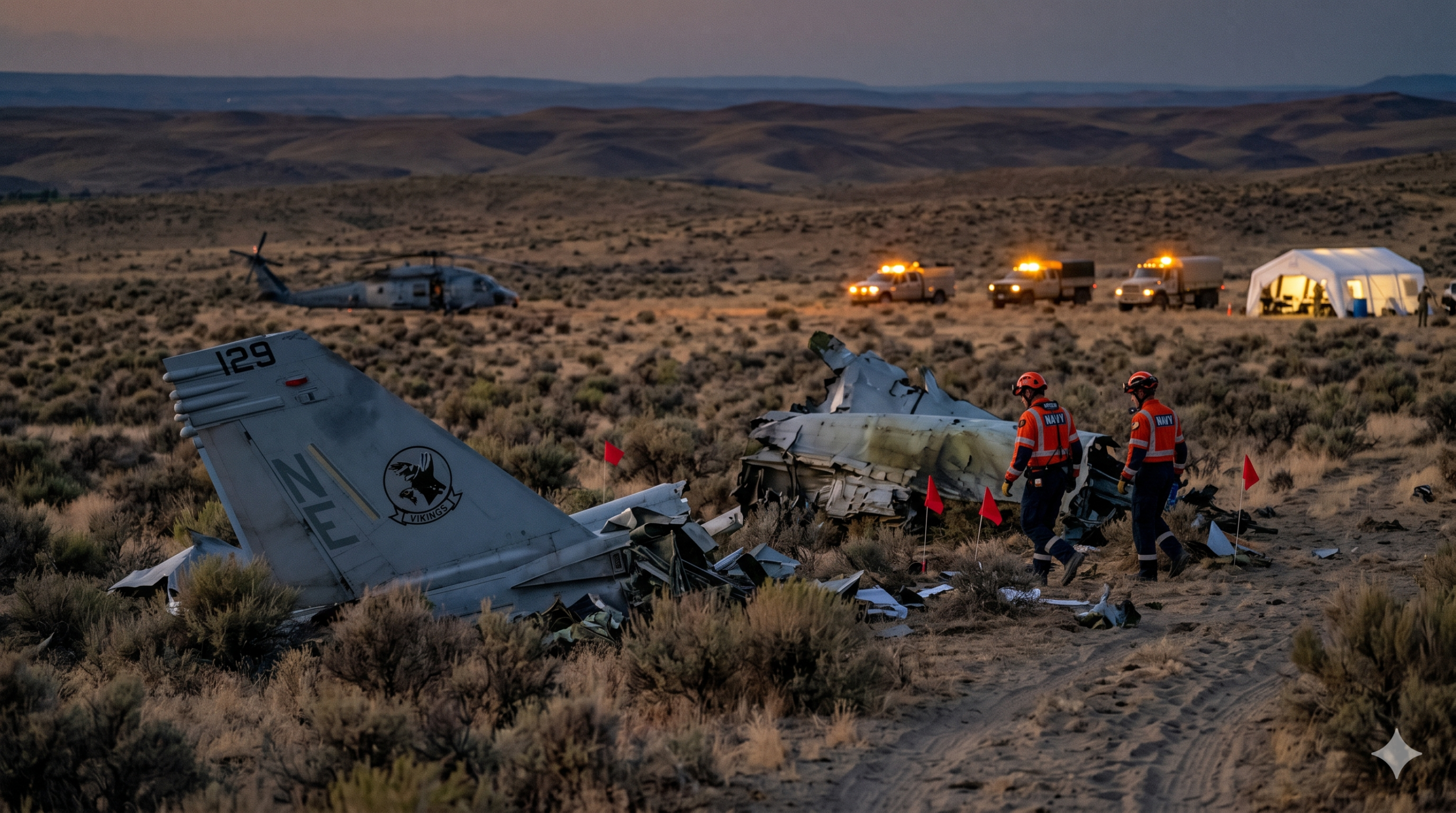
MOUNTAIN HOME AIR FORCE BASE, IDAHO — In a dramatic event that has sent shockwaves through global defense communities, a spectacular mid-air collision involving two United States Navy EA-18G Growler electronic warfare fighter jets has captured worldwide attention. The incident, which took place during an aerial demonstration at the Gunfighter Skies Air Show, resulted in the total destruction of two of the military’s most advanced tactical assets. Beyond the immediate loss of hardware, the accident has ignited fierce debate over peacetime training safety, geopolitical operational strains, and the long-term readiness of American naval aviation.
The Incident: A Sudden, Locked-Together Descent
Mid-air collisions involving cutting-edge, fly-by-wire combat aircraft are exceptionally rare. Modern military aviation relies on hyper-precise instrumentation and rigorous flight discipline, making this public display mishap particularly alarming to defense analysts.
The two EA-18G Growlers, assigned to the Electronic Attack Squadron (VAQ) 129 “Vikings” based out of Naval Air Station Whidbey Island, Washington, were executing a close-formation maneuver approximately two miles northwest of the Idaho base. Eyewitness footage, which immediately went viral across global social media platforms, captured the terrifying sequence of events.
During the demonstration, the trailing Growler appeared to close in on the lead aircraft from behind. Aviation experts suggest the leading jet may have entered the trailing pilot’s under-nose blind spot—a vulnerability that has historically proven catastrophic in formation flying. Within seconds, the trailing jet’s nose struck the underside of the lead aircraft’s rear.
Instead of bouncing apart, the two heavy fighters became physically entangled in mid-air. Stacking on top of one another, the interlocked aircraft pitched upward into a sudden aerodynamic stall, beginning a violent, synchronized tumble toward the desert floor.
The Five-Second Miracle
With the entangled airframes rapidly losing altitude and tumbling out of control, the aircrews faced a highly perilous escape window. Because the jets were rolling vertically while stacked, a premature or delayed ejection risked throwing the aviators directly into the opposing aircraft’s path or fiery jet exhaust.
Remarkably, the advanced automated ejection sequence functioned flawlessly. Within five seconds of the initial impact, four consecutive explosive pops echoed across the airfield as the zero-zero ejection seats blasted the crews clear of the spiraling wreckage. Four distinct white parachutes inflated against the sky just as the dual-jet mass cartwheeled into the ground, exploding in a massive fireball.
Official Statement: “All four aircrew successfully ejected and are being evaluated by medical personnel.First responders are on the scene, and the incident is under investigation.”
— Cmdr. Amelia Umayam, Spokesperson for Naval Air Forces, U.S. Pacific Fleet
While the four aviators survived with minor injuries, the total hull loss of two specialized electronic warfare platforms represents an immense financial and strategic blow to the U.S. Navy.
The Indian Perspective: A Strategic Decision Re-evaluated
As news of the crash reverberated globally, defense circles in New Delhi immediately began analyzing the strategic undercurrents of the incident. Prominent Indian geopolitical commentators, including Prashant Dhawan, pointed out that this mishap casts a retroactive spotlight on the Indian Navy’s multi-billion-dollar fighter procurement history.
Years prior, the Indian government evaluated the Boeing F/A-18 E/F Super Hornet—the direct structural baseline and sibling platform to the EA-18G Growler—for its multi-role carrier-borne fighter requirements. American defense contractors pushed aggressively for the Super Hornet, arguing that its twin-engine reliability and integrated electronic warfare architecture made it the premier choice for India’s indigenous aircraft carriers, such as the INS Vikrant.
Ultimately, New Delhi opted out of the American bid, prioritizing the French-built Dassault Rafale-M. At the time, Washington expressed profound disappointment, citing missed opportunities for deep interoperability between the U.S. and Indian navies.
However, current developments have re-framed that decision in the eyes of regional analysts:
- Production Line Sunsetting: Boeing is already on track to phase out the F/A-18 production line, severely limiting long-term upgrade paths and structural part manufacturing.
- Maintenance and Lifecycle Issues: The recent string of technical mishaps surrounding the Super Hornet/Growler family has raised questions regarding long-term structural fatigue.
- Strategic Independence: By selecting the Rafale, India bypassed the strict end-user monitoring and geopolitical strings frequently attached to top-tier American military hardware.
For Indian defense planners, the Idaho crash serves as a grim validation of their cautious, multi-vendor procurement philosophy, reinforcing the decision to avoid tethering the Indian Navy’s carrier air wings exclusively to a sunsetting American platform.
Systemic Strain: A Broader Crisis in U.S. Military Aviation
Beyond the immediate tactical error of an air-show maneuver, defense analysts view the Growler collision as part of a deeper, systemic malaise gripping the United States military infrastructure.
The U.S. Navy and Air Force have experienced a highly publicized series of setbacks over the last few years. This includes the high-profile crash of an F-35 Lightning II in South Carolina where the jet flew pilotless for miles, alongside recurring maintenance shortfalls across the aging F-15 Eagle fleets.
This pattern of material loss comes at the worst possible time for American defense planners. The U.S. Navy recently sounded a stark alarm, warning Congress that it cannot sustain its current tempo of high-intensity operations in the Middle East and the Indo-Pacific without a massive infusion of funding, spare parts, and fresh personnel.
Geopolitical Friction and Operational Fatigue
The crash coincided awkwardly with high-level geopolitical maneuvers in Washington. Just a day prior to the Idaho incident, government officials held closed-door national security meetings regarding mounting tensions with Iran. Public statements emphasized that “the clock is ticking” for regional diplomacy, yet the visible loss of primary frontline assets weakens the perception of American conventional deterrence.
When front-line electronic attack squadrons—the very units tasked with suppressing enemy air defenses (SEAD) in places like the Persian Gulf or the Taiwan Strait—are losing airframes in peacetime public relations events, it highlights a dangerous convergence of operational fatigue and over-extended resources.
Looking Ahead: The Cost of Replacing the Irreplaceable
The financial toll of the Idaho collision is staggering, with each EA-18G Growler valued at approximately $70 million. However, the true deficit is operational.
| Metric | Impact of the Collision |
| Aircraft Lost | Two (2) Boeing EA-18G Growlers |
| Personnel Status | 4 Crew Members Safe (Stable Condition) |
| Financial Loss | Estimated $140M+ in hardware and specialized pods |
| Strategic Fleet Impact | Critical reduction in VAQ-129 training capacity |
The Growler is not a standard fighter jet; it is a highly specialized electronic warfare asset packed with sensitive jamming receivers, ALQ-218 wingtip pods, and ALQ-99 tactical jamming systems. It is the literal shield that protects standard strike fighters from advanced surface-to-air missile threats. With the production line winding down, replacing these two specialized airframes will be an uphill logistical battle for the Pentagon.
In the coming weeks, the Navy’s mishap investigation board will scrutinize every second of the flight data recorders. While investigators will likely attribute the root cause to pilot spatial disorientation or a blind-spot tracking failure during formation flight, the broader lesson remains.
As geopolitical tensions rise and the demand on U.S. military aviation reaches a breaking point, the margin for error has completely vanished. The world is watching, and the answers found in the wreckage of the Idaho desert will heavily influence the future of global aerial doctrine, safety protocols, and international military alignment.
About the Author