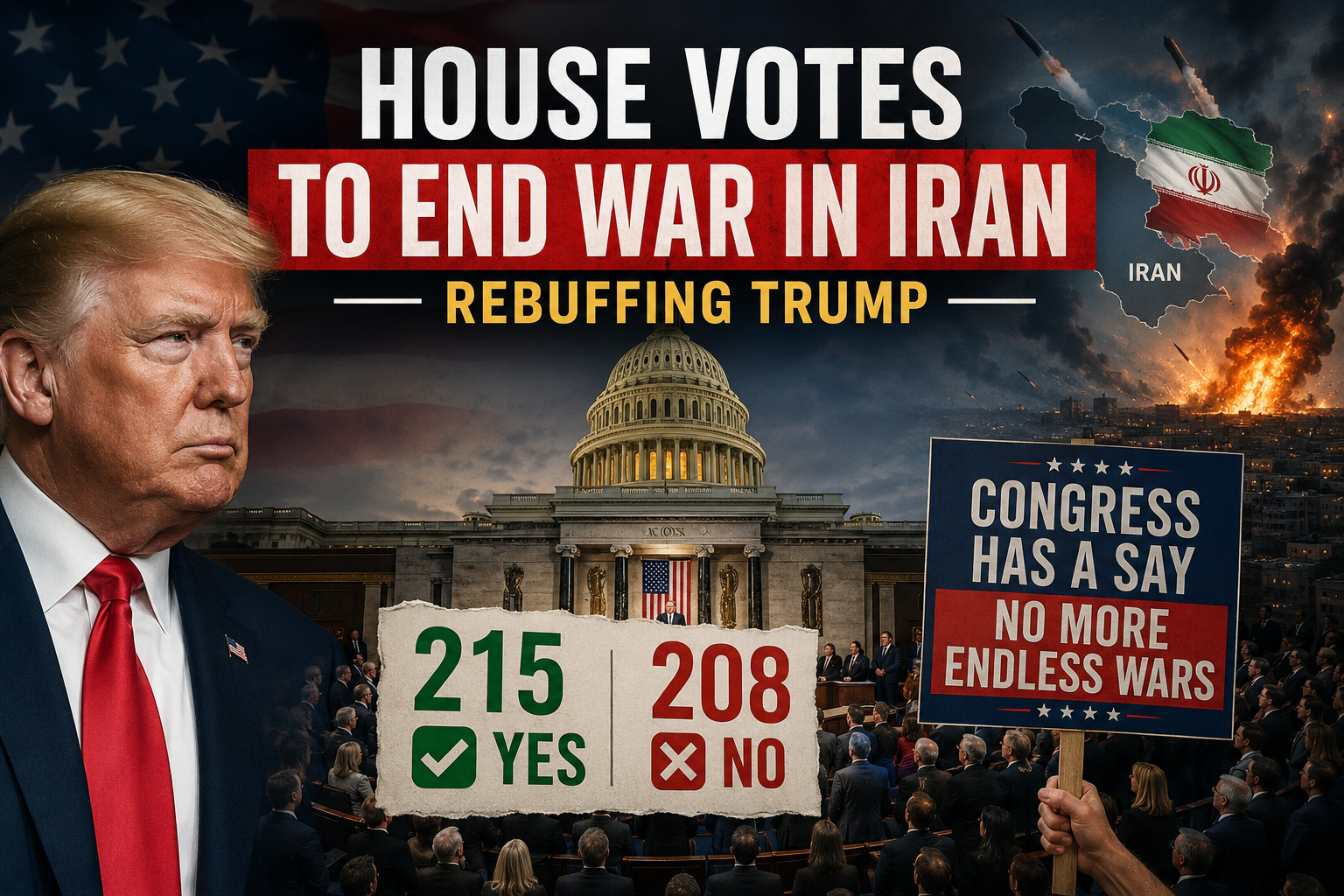
The United States House of Representatives has taken a major step that could reshape the debate over America’s role in the Middle East. In a closely watched vote, lawmakers approved a resolution aimed at limiting further military involvement in Iran, delivering a significant political setback to President Donald Trump.
Although the measure is largely symbolic and does not immediately force changes in military policy, it sends a powerful message from Congress: many lawmakers want greater oversight and clearer objectives before the United States becomes further involved in another prolonged conflict.
The vote highlights growing concerns in Washington about military operations in the region, the risk of escalation, and the constitutional balance of power between Congress and the President.
House Sends a Strong Message on War Powers
The resolution passed the House by a narrow margin of 215-208, reflecting deep divisions in Congress over U.S. policy toward Iran.
Several Republican lawmakers crossed party lines to support the measure, joining Democrats who argued that Congress must play a more active role in decisions involving military action.
The vote comes amid continuing tensions in the Middle East and ongoing uncertainty regarding long-term U.S. objectives in the region.
Supporters of the resolution say it is not about weakening national security but about ensuring that elected representatives have a voice in decisions that could place American service members in harm’s way.
Why the Vote Matters
Under the U.S. Constitution, Congress has the authority to declare war. However, modern military operations are often initiated by presidents under their powers as commander-in-chief.
This has led to decades of debate about how much authority the executive branch should have when engaging in military conflicts.
The latest House vote reflects concerns that military actions involving Iran could expand without sufficient congressional authorization.
Many lawmakers believe that any long-term military engagement should have clearly defined goals, transparent planning, and direct approval from Congress.
Bipartisan Concerns Are Growing
One of the most notable aspects of the vote was the bipartisan support it received.
Several Republican representatives broke ranks with party leadership and backed the resolution, signaling unease about the current direction of U.S. policy.
Supporters argued that Congress must reassert its constitutional role in matters of war and peace.
Some lawmakers emphasized that before military operations continue, the administration should clearly answer several critical questions:
- What is the mission?
- What are the objectives?
- What defines success?
- How long could involvement last?
- What are the risks of escalation?
These concerns have resonated across party lines as Americans continue to debate the nation’s role in global conflicts.
Democrats Claim Political Victory
Democratic leaders celebrated the vote as evidence that lawmakers are willing to challenge the administration’s approach.
Party leaders argued that Congress has a responsibility to provide oversight whenever military force is used abroad.
While the resolution does not immediately change military operations, supporters believe it establishes political pressure for greater transparency and accountability.
The vote also demonstrates that concerns about military involvement in Iran extend beyond traditional partisan boundaries.
Republican Leadership Continues to Support Trump’s Strategy
Despite the outcome, Republican leadership remains largely supportive of President Trump’s approach toward Iran.
Supporters of the administration argue that strong military deterrence is necessary to protect American interests and prevent regional instability.
They maintain that Iran’s actions continue to pose security challenges and that maintaining pressure is essential to preventing future threats.
Administration allies also argue that military readiness and strategic strength have helped protect U.S. interests and allies in the region.
For them, the priority remains ensuring national security while preventing adversaries from gaining strategic advantages.
The Bigger Question: How Much Power Should Presidents Have?
Beyond the immediate political battle, the vote revives a broader debate that has shaped American foreign policy for decades.
Presidents from both major parties have faced criticism for military actions undertaken without explicit congressional declarations of war.
Critics argue that Congress has gradually surrendered too much authority to the executive branch.
Supporters of stronger presidential powers counter that modern threats often require rapid responses that lengthy congressional debates may not allow.
The Iran vote has once again placed this constitutional question at the center of national discussion.
Impact on U.S.-Iran Relations
The House vote does not directly alter diplomatic relations between Washington and Tehran, but it may influence future policy decisions.
International observers are closely watching whether growing congressional skepticism affects future military planning, negotiations, or regional strategy.
For Iran, the vote may be interpreted as evidence of domestic political divisions within the United States.
For America’s allies, it signals that U.S. foreign policy remains subject to intense debate and oversight at home.
What Happens Next?
The future of the resolution remains uncertain.
For any binding changes to occur, additional legislative action would likely be required, including support from the Senate and potential approval hurdles.
Even if the measure does not become law, political analysts believe it reflects a changing mood in Washington.
Lawmakers from both parties are increasingly demanding:
- Greater transparency
- Clear military objectives
- Defined exit strategies
- Congressional involvement in conflict decisions
These issues are expected to remain central topics in upcoming political debates.
Public Opinion Could Shape the Outcome
Historically, public sentiment has played a major role in shaping U.S. military policy.
As voters become more focused on domestic economic challenges, many are questioning the costs and consequences of overseas conflicts.
Future political leaders may face increasing pressure to justify military engagements with clear goals and measurable outcomes.
The House vote suggests that these concerns are already influencing decision-making within Congress.
Conclusion
The House of Representatives’ decision to support a resolution limiting further military involvement in Iran marks an important political moment in Washington.
While the measure may not immediately change events on the ground, it highlights growing bipartisan concern over military strategy, congressional authority, and America’s role in the Middle East.
The vote serves as a reminder that debates over war powers, national security, and foreign policy remain deeply relevant in modern American politics.
Whether this action leads to meaningful policy changes or remains largely symbolic, one thing is clear: Congress is increasingly willing to challenge the executive branch when it comes to decisions about war and peace.
About the Author



1 thought on “Rebuffing Trump: House Votes to End Iran War, Signaling Growing Political Divide in Washington”