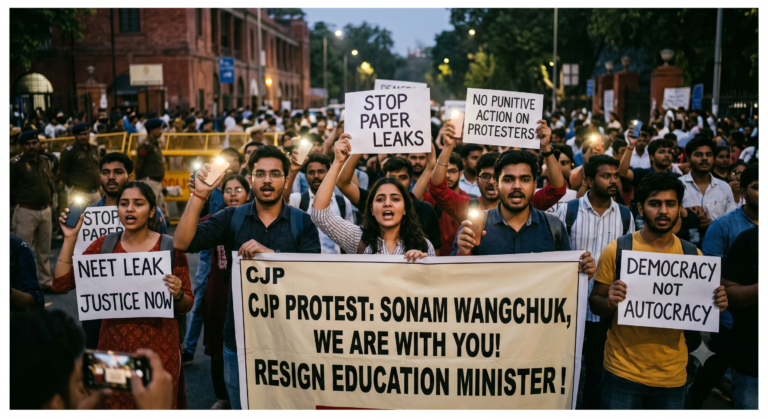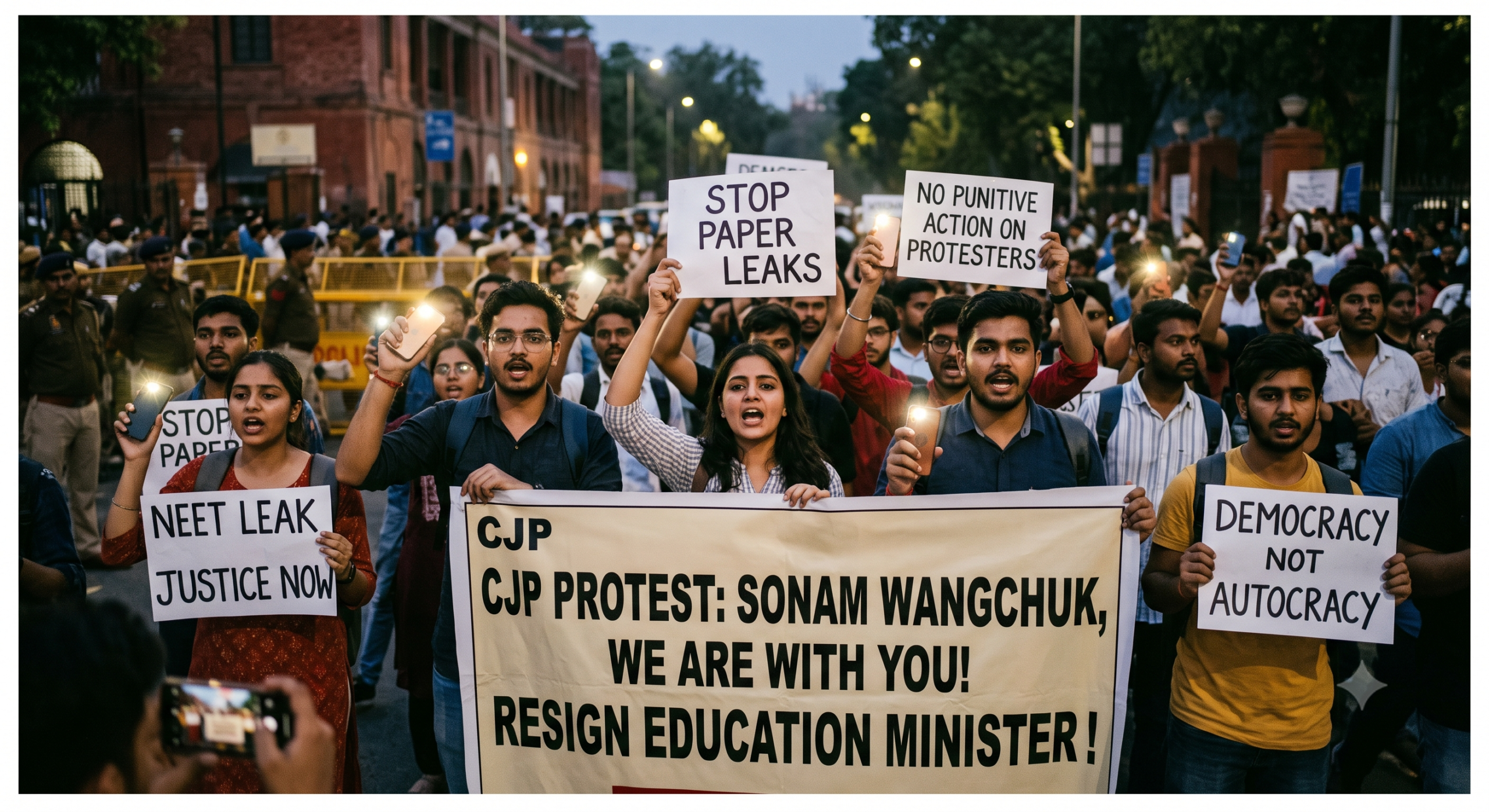
What started as online outrage and viral memes has officially erupted into one of the largest street demonstrations New Delhi has seen in nearly five years.
The national capital is witnessing an unprecedented showdown as the central government and young citizens lock horns over the structural integrity of India’s competitive education system.
The Cockroach Janta Party (CJP)—a youth-driven digital movement that has quickly ballooned into a powerful political force—completely locked down key sectors of the capital this week. Their demand is simple, sharp, and entirely uncompromising: the immediate resignation of Union Education Minister Dharmendra Pradhan over the devastating National Eligibility cum Entrance Test (NEET-UG) paper leak scandals.
With a renowned climate activist entering the critical stages of a hunger strike, nationwide opposition blockades, and the Delhi High Court stepping into the fray, the situation has escalated from a student grievance into a full-blown national crisis.
The Birth of the “Cockroach” Resistance
To understand the sheer scale of the current unrest, one must look at the bizarre origins of the CJP. Founded in May 2026 by digital communications strategist Abhijeet Dipke, the movement was born out of pure indignation. During a Supreme Court hearing, a comment comparing protesting and unemployed youth to “cockroaches” and “parasites of society” went viral. Rather than backing down, India’s Gen Z internet users reclaimed the slur.
What began as a satirical parody of the ruling establishment exploded overnight, garnering over 22 million social media followers and outpacing the traditional political machines. However, the satire rapidly hardened into real-world resistance when the structural failure of the NEET medical entrance exams came to light. For millions of middle-class families who bankrupt themselves to pay for private coaching, the reality of leaked question papers sold to the highest bidder was the ultimate breaking point. The CJP transitioned from the digital space to the streets, capturing the raw frustration of an entire generation.
1. The High-Stakes Standout: Sonam Wangchuk’s Ultimatum
Fasting climate activist Sonam Wangchuk, who has been the moral anchor of the movement, was recently shifted under heavy medical supervision to Medanta Hospital in Gurugram following escalating health concerns. The gravity of his ongoing indefinite hunger strike forced high-level interventions from the Centre, including bedside visits by Union Ministers JP Nadda and Jitendra Singh to assess his condition and attempt to de-escalate the crisis.
Following these high-level discussions, Wangchuk revealed that the Centre has formally assured him it will “positively consider” the resignation of Education Minister Dharmendra Pradhan to ensure structural accountability for the NEET failure.
However, Wangchuk is refusing to break his fast without solid legal ironclads for the youth. In a poignant, widely circulated letter addressed directly to the government, he set a strict, non-negotiable condition for ending his strike:
“I respectfully request an unequivocal assurance from the Government that none of the young protesters will face any punitive or retaliatory legal action for participating in this movement. Their only ‘offence’ has been to raise their voice for a fair and accountable education system.”
While a visiting delegation of Opposition MPs and CJP founder Abhijeet Dipke have publicly urged Wangchuk to break his hunger strike out of concern for his deteriorating vital signs, the activist remains stubborn. His stance remains clear: “I want to live, but not at the cost of the youth.”
2. Battlefield Delhi: Tear Gas, Tethers, and the High Court
The operational peak of the unrest manifested during the CJP’s massive “Chalo Sansad” (March to Parliament) initiative. Seeking to block the march, the Delhi Police enforced stringent prohibitory orders under Section 163 of the Bharatiya Nagarik Suraksha Sanhita (BNSS), shuttered 16 strategic metro stations, and executed a localized mobile internet blackout across central administrative zones.
Despite the logistical clampdown, tens of thousands of student demonstrators bypassed security cordons to converge on Jantar Mantar before pushing forcefully toward the Parliament buildings. By mid-afternoon, central Delhi hubs including Connaught Place, India Gate, and Raisina Road transformed into active confrontation zones as law enforcement deployed physical batons (lathi-charge) and heavy tear gas salvos to fragment the advancing crowds.
[Protest Demands] ──> [Chalo Sansad March] ──> [Section 163 Prohibitions]
                                                        │
  ┌─────────────────────────────────────────────────────┴──────────────────────────────────────────────────────┐
  ▼                                                     ▼                                                              ▼
[Connaught Place / Raisina Road]              [16 Metro Stations Shuttered]                             [Heavy Police Crackdown]
- Heavy tear gas & baton charges applied      - Major transport gridlock across capital                 - Over 178 total injuries reported
- Confrontation zones clear by evening        - Mass commutes disrupted throughout Delhi                - 70+ student activists detained
The Human and Legal Cost:
- Casualties: The violent clashes left at least 178 individuals injured, including 118 security personnel who were caught in the chaos. A young female protester remains in critical condition in the Intensive Care Unit (ICU) at Ram Manohar Lohia (RML) Hospital after sustaining severe injuries.
- Mass Detentions: At least 70 student activists were formally detained during the Monday march. In response, the CJP and the Aam Aadmi Party (AAP) have established a joint legal coalition to provide free legal aid to all arrested students.
- Judicial Intervention: The legal fallout has reached the highest level. The Delhi High Court has officially issued notices demanding comprehensive explanations from both the Centre and the Delhi Police regarding the allegations of “brute, unprovoked force” used against peaceful assembly. The bench explicitly ordered the immediate preservation of all relevant CCTV and security footage. Furthermore, defense advocates are pushing for the court to summon Additional DCP Sandeep Lamba over visual evidence allegedly showing the physical assault of a woman standing on the sidelines of the protest.
The Delhi Police have firmly defended their tactical actions, presenting video logs indicating that the assembly transitioned into an unruly, aggressive mob that targeted security personnel with stones and blunt objects. Six First Information Reports (FIRs) have been registered across several police stations, with authorities explicitly probing a “larger and criminal conspiracy” designed to intentionally manufacture violence in the capital.
3. Deliberations at a “Neutral Venue”
In a unique tactical maneuver, the leadership of the CJP has publicly expressed a willingness to engage in direct negotiations with the central government—but they are refusing to play by standard bureaucratic rules.
CJP spokesperson Saurav Das announced that while the movement is open to dialogue, its representatives will not step foot inside any ministry offices or private ministerial residences. Citing logistical and severe “security concerns” for their student delegates if they enter high-security government zones, the CJP has drawn a clear line regarding the location of the talks:
“They have called us. We will not go to their office or their residence. The talks will either happen at Jantar Mantar or at a neutral location… We can meet openly at the Constitution Club of India.”
With Union Minister JP Nadda tentatively scheduled to chair the upcoming meeting with the CJP delegation, the dispute over the geographic setting remains a key point of friction before formal policy discussions can even begin.
4. The Political Firestorm and the Government’s Defense
The intense student unrest has quickly escalated into a national political firestorm, triggering sweeping solidarity blockades by opposition parties across multiple states, including Kerala, Assam, and Jammu and Kashmir. The domestic political temperature reached its boiling point when top opposition leaders—including Rahul Gandhi, Priyanka Gandhi Vadra, and Samajwadi Party chief Akhilesh Yadav—staged an aggressive, unscheduled sit-in directly outside the Prime Minister’s official residence, resulting in their brief police detention.
Rahul Gandhi escalated the rhetoric at a high-profile party press conference, appearing with a symbolic black arm band to emphasize that over 150 critical paper leaks have severely undermined the academic landscape over the last decade.Gandhi lambasted the administration for “zero convictions” despite these recurring systemic failures, noting that millions of lower- and middle-class student families are facing financial and psychological ruin.
                     [NEET-UG Systemic Crisis]
                                 │
         ┌───────────────────────┴───────────────────────┐
         ▼                                               ▼
  [The Opposition Stance]                        [The Government Defense]
  - Led by Rahul Gandhi & CJP                    - Articulated by Dharmendra Pradhan
  - Demand: Resignation of Minister              - Claim: Students used as "political tools"
  - Highlight: 152 leaks over 10 years           - Focus: Monopolizing the Monsoon Session
  - Action: Sit-ins & national blockades         - Commitment: 100% open to parliamentary debate
Union Education Minister Dharmendra Pradhan has hit back fiercely against the protests. He accused the Congress party and the CJP of explicitly exploiting anxious students as political leverage to intentionally disrupt the ongoing Monsoon Session of Parliament. Taking to social media platform X, Pradhan argued:
“Shri Rahul Gandhi and the Congress chose to stage a dharna outside the Hon’ble Prime Minister’s residence, causing inconvenience to the public and disregarding established security protocols… For Rahul Gandhi, this is not about students. This is about manufacturing confrontation after every genuine avenue for discussion has been opened.”
Pradhan reiterated that the current administration remains “100% committed to discussing NEET and addressing every genuine concern of our youth on the floor of the House,” concluding that the country’s youth deserve far better than being utilized as functional props in a calculated political campaign.
Summary of the Current Conflict
| Metric / Issue | Current Status & Details |
| Core Demand | Immediate resignation of Union Education Minister Dharmendra Pradhan over NEET paper leaks. |
| Sonam Wangchuk’s Status | Shifted to Medanta Hospital; continuing fast pending written immunity for young protesters. |
| Security Mobilization | 20 additional CRPF companies deployed to Delhi from West Bengal by the Home Ministry. |
| Legal Action | Delhi High Court demanding records from Centre/Police; 6 criminal conspiracy FIRs filed. |
| Casualty Count | Over 178 total injuries (including 118 police personnel); 1 protester in critical condition in the ICU. |
What Happens Next?
With the Ministry of Home Affairs ordering the swift, immediate deployment of 20 additional CRPF companies drawn from West Bengal to fortify the perimeter of the capital, New Delhi remains a virtual fortress. Heavy steel barricades, razor wire, and deep security checkpoints continue to restrict access to crucial political arteries, including Parliament House and Rafi Marg.
The leadership of the CJP has issued a stern, final warning: if the central government does not fully capitulate to their core conditions—comprehensive examination reform, direct judicial accountability, an immediate ministerial exit, and absolute protection for student voices—they will expand their ground operation significantly. CJP spokespeople have warned that “millions more will come” to occupy the capital if their demands are ignored. What began as an isolated structural critique of a medical entrance examination has fundamentally transformed into a sweeping, historical referendum on the economic anxieties, structural safety, and long-term future of India’s youth.
Read More:
-

Mecca Under Air-Raid Alert as Houthi-Saudi Conflict Escalates
Mecca, Saudi Arabia | September 2026 Mecca, the holiest city in Islam, was placed under a brief emergency
-

The Mecca Pact: How Saudi Arabia, Turkey, and Pakistan Just Redrew the Global Power Map
On August 7, 2026 history took an irreversible turn in the holy city of Mecca. Inside the marble
-
The Breaking Point: Inside Delhi’s Massive Student-Led Siege Over the NEET Paper Leak
What started as online outrage and viral memes has officially erupted into one of the largest street demonstrations
About the Author