On August 7, 2026
history took an irreversible turn in the holy city of Mecca. Inside the marble corridors of Al-Safa Palace, overlooking the Grand Mosque, three of the most influential leaders in the Islamic world gathered around a single mahogany table.
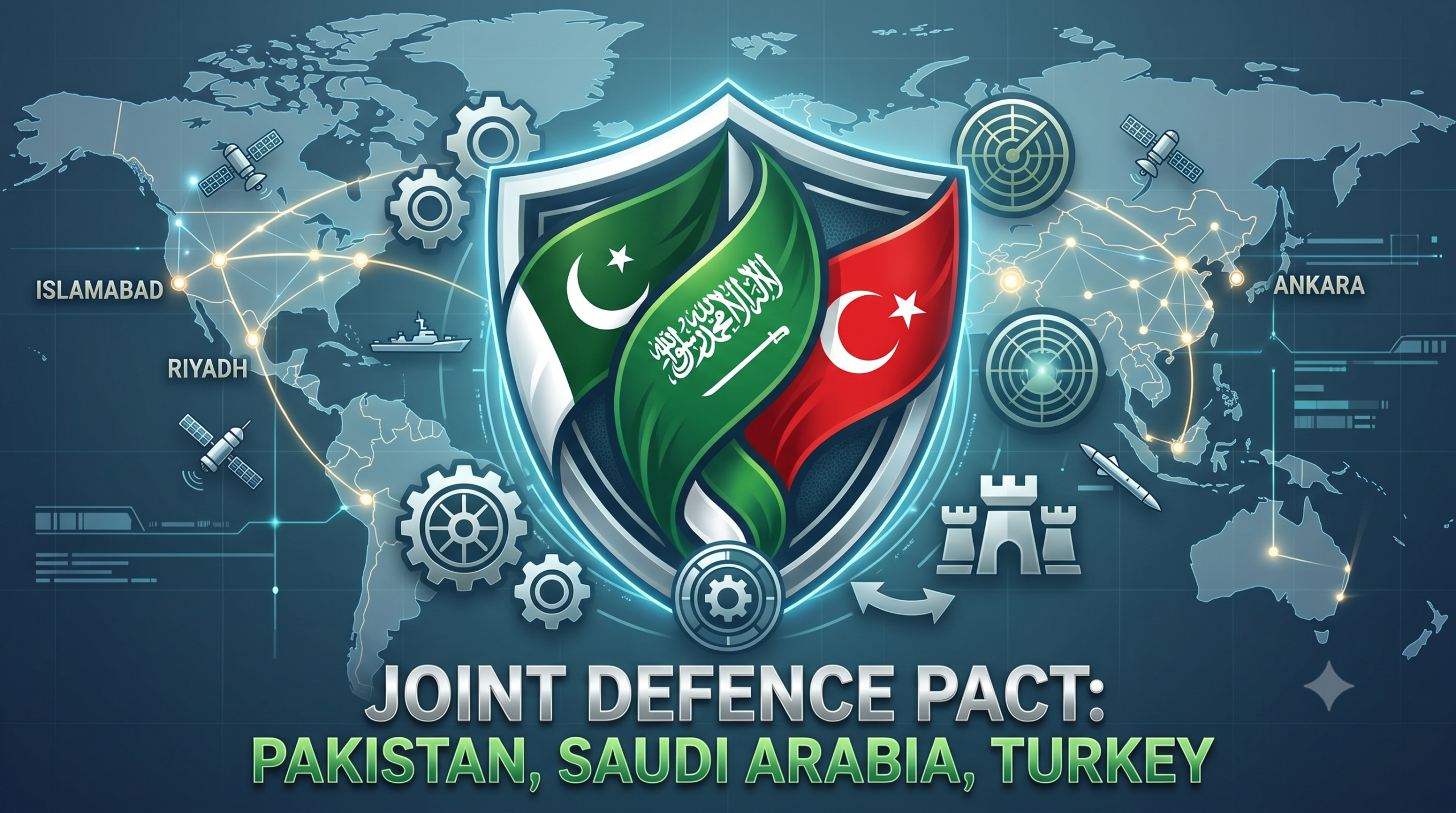
Saudi Crown Prince Mohammed bin Salman, Turkish President Recep Tayyip Erdogan, and Pakistani Prime Minister Shehbaz Sharif put pen to paper on a historic mutual security agreement: The Mecca Joint Defence Agreement.
The central clause of the treaty sent shockwaves through foreign ministries from Washington and Brussels to Beijing and New Delhi: An attack on any one member state will be treated as an direct attack on all three.
In a single afternoon, the trio formed a formidable military triangle uniting Gulf capital, Turkish high-tech defense industrial manufacturing, and Pakistan’s massive standing military and nuclear deterrence.
What drove these three nations into a mutual defense pact? How does it redefine the global balance of power?
1. The Anatomy of a Super-Alliance: What Each Nation Brings
To understand why international security analysts are calling this the most significant realigning shift in West Asia in over half a century, one must examine the specific assets each member brings to the table. This isn’t merely a political photo-op; it is a synergistic fusion of money, technology, and sheer force.
Saudi Arabia: The Financial Engine & Religious Anchor
Saudi Arabia provides immense capital reserves, sovereign wealth backing, and unrivaled regional influence. With defense expenditures consistently ranking among the top five globally, Riyadh brings financial firepower capable of funding massive joint- R&D ventures, weapons production facilities, and long-term infrastructure. Beyond economics, its status as the Custodian of the Two Holy Mosques gives the alliance symbolic legitimacy across the global Muslim world.
Turkey: The NATO Industrial Powerhouse
Turkey brings advanced technological capabilities, combat-proven military hardware, and a world-class defense manufacturing ecosystem. As NATO’s second-largest military power, Ankara has spent two decades building domestic defense self-reliance. From Bayraktar combat drones and fifth-generation fighter jet programs to stealth frigates and advanced electronic warfare systems, Turkey provides the alliance with cutting-edge technology independent of Western export restrictions.
Pakistan: The Strategic Shield & Nuclear Deterrent
Pakistan brings sheer force and strategic depth. Boasting an active military force of over 600,000 battle-tested troops, Pakistan’s armed forces bring decades of experience in counter-insurgency, desert warfare, and mountain operations. Crucially, Pakistan is the only nuclear-armed country in the Muslim world, providing an implicit umbrella of strategic deterrence that fundamental reshapes how potential aggressors view the alliance.
| Nation | Primary Strategic Contribution | Key Military/Economic Asset |
| Saudi Arabia | Financial Capital & Regional Depth | Public Investment Fund (PIF) & Strategic Oil Reserves |
| Turkey | Defense Technology & NATO Integration | Indigenous Drone Warfare (UAV/UAVs), Stealth Shipbuilding & Avionics |
| Pakistan | Combat Personnel & Strategic Deterrence | 600,000+ Active Personnel & Nuclear Arsenal Capability |
2. Why Now? The Catalysts Behind the Alliance
The Mecca Agreement did not materialise overnight. It is the culmination of nearly two years of discreet, high-level strategic negotiations accelerated by unprecedented regional instability.
The Crumbling Western Security Umbrella
For decades, Gulf nations relied heavily on security guarantees from Washington. However, shifting American priorities, political volatility in Washington, and conditional arms sales created a growing sense among regional leaders that relying on external powers for core security was an unacceptable risk. Gulf states realized they needed an indigenous, self-sustaining security framework.
Escalating Regional Flashpoints
The Middle East and its maritime arteries have faced unprecedented volatility over recent years:
- Persistent threats to commercial shipping lanes in the Red Sea and Strait of Hormuz.
- Drone and missile proliferation by non-state actors targeting critical civilian and energy infrastructure.
- Escalating state-on-state tensions across the Levant and Iranian plateau.
By uniting, Saudi Arabia, Turkey, and Pakistan create an internal, self-sufficient defense network that can project stability across the Arabian Sea, the Red Sea, and the Eastern Mediterranean.
The Economic & Technological Synergy
Defense manufacturing is extraordinarily expensive. By pooling their financial resources and engineering talent, Turkey can scale its defense production, Saudi Arabia can localize military technology under its Vision 2030 initiative, and Pakistan can modernize its defense platforms while easing domestic economic pressures through strategic military exports.
3. Inside the Agreement: Core Legal & Military Provisions
Grounded in Article 51 of the United Nations Charter—which explicitly recognizes the inherent right of sovereign states to individual and collective self-defense—the Mecca Joint Defence Agreement rests on four core operational pillars:
I. The Collective Defence Clause
The cornerstone of the pact mirrors NATO’s famous Article 5. An act of unprovoked aggression or armed invasion against the territory, sovereign airspace, or maritime boundaries of one member state obligates the other two to respond using all necessary means, including military force.
II. Deep Industrial Co-Production
Rather than relying on foreign weapon purchases, the three nations are establishing joint defense production centers. Turkey will transfer advanced manufacturing technology to facilities in Saudi Arabia and Pakistan, enabling the co-development of next-generation UAVs, air defense systems, and armored platforms.
III. Integrated Intelligence Exchange & Command
The pact establishes a trilateral Joint Operations Cell headquartered in Riyadh, with secondary centers in Ankara and Rawalpindi. This framework allows real-time satellite imagery sharing, early-warning radar integration, and joint cyber-defense operations across the Indian Ocean and the Middle East.
IV. Trilateral Military Exercises & Doctrine
Starting in late 2026, the three nations will launch annual joint war games titled “Shield of Peace.” These exercises will train air force pilots, naval commanders, and ground forces to operate under unified command and control protocols, standardizing tactics and communications across all three militaries.
4. How the “Islamic Trio” Compares to Other Global Alliances
Media headlines were quick to brand the deal an “Islamic NATO.” However, comparing the Mecca Pact to legacy Western frameworks reveals distinct structural differences.
Unlike NATO, which relies on a centralized military command structure dominated by a single superpower, the Mecca Pact operates as a tri-polar alliance. Each country retains complete independence over its domestic defense policy, using the alliance primarily as a force multiplier and strategic deterrent against external aggression.
5. Global Geopolitical Fallout: Who Wins, Who Watches?
The ink was barely dry on the Mecca Agreement before analysts in major world capitals began recalibrating their strategic calculations.
Washington & Brussels: Cautious Observation
For the United States and its European allies, the deal is a double-edged sword. On one hand, a stable, self-reliant defense alliance in West Asia reduces the burden on American military deployments in the region. On the other hand, Turkey’s central role as a NATO member co-founding a major non-NATO security alliance introduces complex questions regarding defense technology transfers and diplomatic alignment.
New Delhi: Strategic Recalibration
In India, foreign policy strategists are carefully evaluating the pact. The inclusion of Pakistan alongside major Indian trade and energy partners like Saudi Arabia creates a nuanced diplomatic puzzle. India will likely deepen its bilateral security, trade, and intelligence ties with Saudi Arabia while monitoring defense exports from Ankara to Islamabad.
Iran & Regional Powers: Balancing Act
While the signatories emphasize that the Mecca Agreement is strictly defensive, regional neighbors like Iran are observing developments closely. The creation of a unified military bloc along Iran’s western, southern, and eastern borders fundamentally shifts the regional strategic calculus, likely pushing Tehran toward deeper diplomatic engagement with its neighbors to prevent isolation.
Beijing & Moscow: Economic & Geopolitical Opportunism
China and Russia view the deal through the lens of a multipolar world order. Beijing, which brokered the Saudi-Iran diplomatic reconciliation in 2023, sees a stable West Asia as essential to its Belt and Road Initiative (BRI). Moscow views the alliance as further proof that middle-tier powers are increasingly willing to build independent security structures outside Western control.
6. The Long-Term Horizon: What Happens Next?
The signing of the Mecca Pact is only the opening act. The true test of this mega-alliance will be how quickly and effectively its member states can translate diplomatic promises into operational military reality.
Over the next 12 to 24 months, observers should look for three crucial indicators:
- Concrete Defense Industrial Projects: The announcement of specific co-developed defense projects—such as joint Turkish-Pakistani fighter jet manufacturing funded by Saudi capital.
- Naval Domain Integration: The deployment of joint naval patrols along critical sea lines of communication in the Bab-el-Mandeb, the Strait of Hormuz, and the Arabian Sea.
- Potential Expansion: Whether other regional nations—such as Qatar, Bahrain, or Oman—apply for observer status or limited partnership within the framework.
Summary: A Redefined World Order
The Mecca Joint Defence Agreement marks a decisive shift away from twentieth-century security models. By combining financial wealth, advanced technology, and raw military capacity, Saudi Arabia, Turkey, and Pakistan have constructed an indigenous defense triangle capable of shaping the destiny of West Asia and the wider global order for generations to come.
As the geopolitical landscape shifts from unipolar dominance to a complex multipolar reality, the Mecca Pact stands as a stark reminder: the future of global security is no longer written solely in Western capitals, but in the historic crossroads of Asia, the Middle East, and the Islamic world.
About the Author